The best market I’ve ever seen

Visiting the local market is a great way to get the vibe of any city. You get to see what people are eating, how much they are spending, and how they treat each other. Based on my experience in Bujeon Market (부전시장), Busanites eat a lot of fish, for a damn good price, and the market is a place for business not chit chat.

I’ve visited markets in Italy, Spain, Japan, Turkey, and Morocco, as well as other markets in Korea, but Bujeon Market instantly took the place of best market ever in my mind. From a tourist’s point of view, it has everything you could possibly want as you clumsily stumble through another culture’s place of trade and gawk at the common place while trying not to be overly conspicuous.

Bujeon Market sells everything you could possibly want (and many things you probably don’t). They have stacks of fruits and vegetables piled into little red plastic baskets (you buy by-the-basket – trying to buy 4 apples won’t work). There is an enormous variety of fish – fish that’s still swimming around, fish that is hacked into pieces, and fish dried with a shocked expression similar to Munch’s famous paintings. Of course there is meat as well, but it hardly bears mention as its fascination pales in comparison to the buckets of octopus whose contents look like they might escape back to the sea from which they were pilfered. In terms of things you probably don’t want, there’s a wide selection of cheap lingerie and Ajumma-style (even cheaper) brilliantly-coloured hiking clothes.

There’s also an area with spices on par with the Grand Bazaar – you will know you have found it when your nose becomes overwhelmed and you involuntarily collapse from the olfactory assault. Additionally, there’s an adjacent section on the periphery that has ingredients for traditional medicine. To my eye, the ingredients resemble dried twigs and bark – I will try it out if someone can tell me what to do with it.

Besides the contents of the market, the determining factor in placing this as best market ever is that there are, literally, no other tourists. Bujeon market is a free-market area of no-frills, pragmatic trade – there’s no kitsch for tourists because there aren’t any. Instead, old ladies take up the breadth of the thoroughfare with their carts of watermelons (perhaps capturing the impulsive watermelon-buying market) and guys weaving through the crowd with boxes of goods strapped to the back of their mopeds.

Not to be missed!


Korea has its own way of renting apts

wpid-wp-1403580935927.jpeg


Korea’s system for renting apartments is pretty interesting and is unique to Korea. When I first arrived, I asked several people about short-term housing rental, and they all said the same thing, “you will have to pay the deposit”. Paying a deposit didn’t seem like a big deal. In Canada, the deposit is half of one month’s rent, so it’s several hundred dollars at most. When I asked how much the deposit should be, they said usually ten to thirty thousand dollars. What?!

The Korean rental system is unique. You pay a very large deposit, say $50,000, and then live rent free. The landlord makes interest off your deposit and gives it back when you move out. The system is called Jeonse.

The first line in the advertisement above says Halla Vivaldi 422 – it’s the name of the building where I’ve been living. The building is a modern high-rise similar to apartments in downtown Vancouver. The size of the studio is listed as 18 pyeong. A pyeong is 3.3 square meters and is also the size of 2 tatami mats (rooms in Japan are often measured in tatami mats).

The four options for rental prices are listed in man won, or multiples of 10,000 Korean won. You can pay a smaller deposit of $2000 and then pay $480/month or pay a larger deposit of $10,000 and then pay only $400/month.

However, it seems that the Jeonse system is in decline. As you can see from this ad, the ratio of deposit to monthly rent is not large. From what people have told me, the system is being used less and less with newer apartments. Still, if you have the cash, Korea is the place to be for cheap rent.


Strange Korea: Couple Tees

20140609_170756

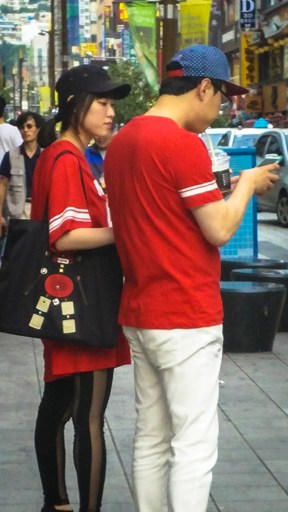
Korea is crazy for couples. It’s so crazy that it’s common for couples to display their affection by dressing in matching outfits. Korean couples aren’t just dressing similarly from having spent countless days together developing a strong emotional connection. They dress in exactly matching clothes bought for the sole purpose of identifying that they are, in fact, a couple and demonstrating to society that their love for each other is so profound that it emanates from their inner-core and manifests itself as matching textiles.

For my Yankee brain, with its deep ingrained necessity for independence and non-conformity, the Couple Tee, as it’s called in Konglish (Korean-English), is unfathomable, incomprehensible, and causes a small amount of vomit to reach my mouth each time I encounter this aberration of societal behaviour. My immediate reaction, after my involuntary one has subsided, is to be subversive. Is it possible to get custom made Couple Tees with “Friend” written on one and “with Benefits” written on the other? Or how about getting 3 shirts made with “open”, “relation”, and “ship”? One could go for a stroll as a couple and see if anyone wants to wear the 3rd shirt.

Below is an example of a Couple Tee pair. The non-sensical English writing on the shirts will be the topic of a future blog post. Non-sensical English on clothes is common here as is the liberal use of the word fuck – it makes for some interesting clothing options. Needless to say there is sufficient demand for Couples Tees that an industry exists to provide them. Fortunately, this subdivision of the clothing industry had the ingenuity to diversify its products into Couple Hats as well. This leads me to imagine: what is the ultimate Couple article of clothing? I’m imagining a colour-coordinated four-legged couple-onesie with shared poop flap – that would be next-level intimacy.

20140615_150313

Module III: Korean!

DSCF8404

Now that I’m completely fluent barely conversational in German and Japanese, it’s time for the third language: Korean!

Although Korean is unrelated to Japanese, it does have a lot of similarities. The word order is the same (Subject-Object-Verb), there are particles to mark the different parts of speech, adjectives and verbs are conjugated, and there are different rules based on the level of politeness and formalness required. This is all similar to Japanese.

A major difference is that Korean doesn’t have Chinese characters. As much as I enjoyed learning kanji in Japanese, I’m very thankful for the ultra-compact and logical Korean hangul alphabet which is easily memorized in 1 day. In the early 1900s, the language switched from Chinese characters to hangul and by the 1950s the use of Chinese characters was more or less phased-out. The hangul alphabet, which was designed in the 15th century, is extremely interesting. The shapes of the letters actually relate to the shape your mouth makes when saying them (see http://en.wikipedia.org/wiki/Hangul#Consonant_design).

That being said, Korean is supposed to be a difficult language to learn. The US Foreign Service puts Korean in category 3 (along with Japanese, Arabic, and Chinese) which ends up being about 4 times as many hours of study than category 1 languages like Spanish, French, and Italian. Keep in mind this is from the perspective of native-English speakers only — maybe Korean is easy if you speak Japanese natively!?

What did I learn from Module II: Japanese?

  • It’s great to have someone to work with one-on-one. Really it’s a must-have. In Japan, I was able to do language exchange with Sachiko for about an hour every day and also spoke with Yuka and Pon at the izakaya in the evenings. It was really a great situation for learning. That coupled with studying for a couple hours per day was sufficient to make decent progress.
  • Avoid foreigners. Even though there were a fair number of foreign visitors, Myoko Kogen is still very very Japanese i.e., it’s hard to find espresso. In Hakuba, it was easy to find espresso, i.e. not very Japanese. Go somewhere with less foreign influence and bring along a tin of Illy coffee.
  • Making flashcards is great fun. Daiso sells blanks.
  • Don’t spend a week reading reviews about ski gear instead of studying.
  • You won’t have 6-pack abs if you drink a litre of beer everyday no matter how much tofu and daikon salad you eat (see getdrunknotfat.com).

Goals for Module III: Korean:

  • Find a place with a nice beach but few foreigners. Right now I’m in Busan which has nice beaches but too many foreigners.
  • Get myself into a situation where I can speak Korean for at least a couple hours per day.
  • Learn how to surf or go sea kayaking or do some other fun water sport.
  • Koreans love to hike! When in Rome…
  • Make as many KakaoTalk friends as possible and text them in Korean! Plus send them hilarious emoticons like these.
  • Drink less beer! As the name of the popular Korean beer, Cass, would imply, Korean beer sucks. Stick with soju!
  • Drive around in a baller Hyundai with my tinted windows rolled down while I talk on my giant waffle-sized Samsung phablet.
  • I will be hard pressed to have as an amazing experience as I did Japan, but I will try my best. がんばります!


Japan in Pictures: Jan to May

Best 3 months ever! Last day in Myoko Kogen, Japan :-(

IMG_4771

The life of a ski bum is kind of awesome, but combine ski-bum life with the best place in the world to travel (Japan!), and you have a recipe for the best time of your life. The past few months have not only been amazingly fun but also an extremely rewarding and unique travel experience. Apparently, I’ve been having so much fun, that I haven’t kept up with blogging, so here are the last 3 months in short-form.

Myoko Kogen (妙高高原) is a set of about 6 ski resorts around the base of a dormant volcano, Mt Myoko. To get here you take a 40 minute train ride from Nagano city. I’ve been staying in the Shin-Akakura village in Myoko Kogen.

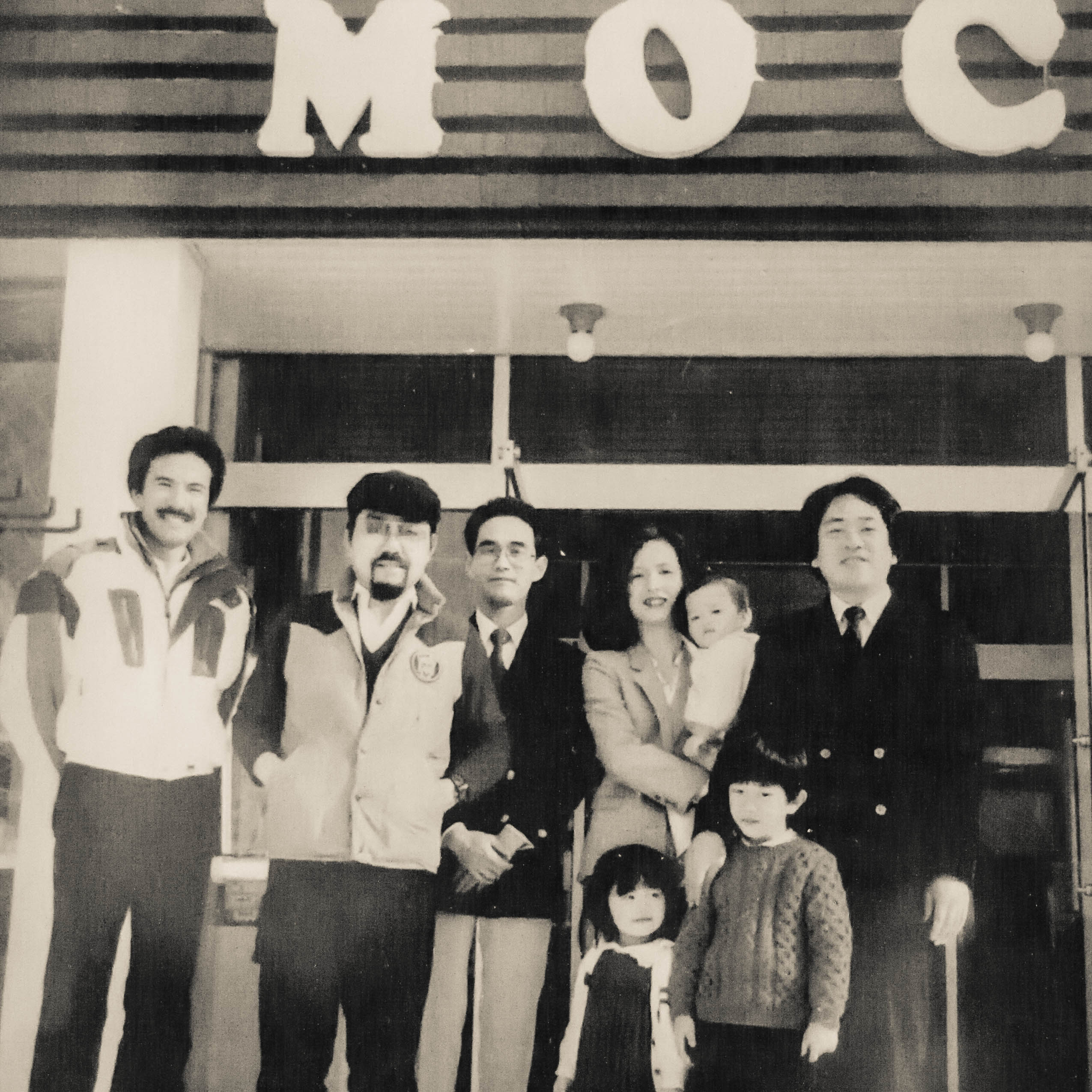
I came to Myoko Kogen after reading about it on powderhounds.com and arrived with no real “plan” other than to ski and learn some Japanese. Upon arrival, I went to the tourism office, and they kindly called a hotel for me. A young man from Hotel Moc came to pick me up.

That was January 13th! In the three months since, I have transitioned from guest into part-time employee into extended family member.

After about 2 weeks of living in the hotel, the couple that own it, Ken and Sachiko, asked me if I would like a part-time job. At first I wasn’t sure; after all, I’m on vacation, right? But Sachiko insisted the work would not be difficult, so I agreed. I would watch the front desk on weekends while Sachiko was busy in the restaurant, and every morning, we would spend an hour speaking in English and then in Japanese. In exchange for the work, I could stay in a worker’s room free-of-charge. The room was very simple with a tatami floor with a futon for sleeping, a low table, and a kerosene heater. For me it was perfect! It was the most minimal setup, but I was grateful for a space to call my own. Also, she gave me a ski pass for the mountain — a sweet gig if there ever was one!

So that was my life for about 6 weeks: Japanese breakfast in the morning followed by Japanese/English language exchange, hit the slopes for a few hours, eat some ramen on the hill, ski some more, get cleaned up in the onsen, and then go to the local izakaya to have dinner and chat with the owners. A rough existence to say the least.

The izakaya, Pontaro Izakaya (ポン太郎居酒屋), is run by Pontaro and Yuka, and this is where I had dinner every night. After chatting with them nightly for a few weeks, I eventually asked them if they needed arbeito (part-time worker). Yuka was thrilled. She gave me an apron and headband and put me to work washing dishes. In exchange for my menial work, they provided me with beer, sake, and dinner. I have now entered ski-bum heaven — my only expense was a daily bowl of ramen for lunch which left me free to spend spend spend on new ski gear.

During those first 6 weeks, I really became a part of the community here.  I made friends on the ski hill with a cute young couple from Niigata city, and I went to Niigata to visited them. I chatted with whoever came to the izakaya, including Kao-chan, who kindly took me telemark skiing for the first time, pro-skiers with Moment (I bought Moment Exit World powder skis), Bill, who runs a backcountry touring company and kindly drove me to Nagano for my ski purchases, and lots of colourful locals and Japanese skiers from out of town. People I had never met before would come in to the izakaya and say they had heard of me — Yuka would tease me for being famous. でも、ゆうめいになりたくない (translation).

There have been so, so many great experiences here. I helped out with building the kamakura for the ski festival, and the community celebrated together with hot sake and food. At Yuka’s birthday bash at Pontaro’s, I helped out serving nigirizushi and had the pleasure of playing sushi chef for a night. I came to Sachiko and Ken’s shinto blessing and ground-breaking ceremony for their new house and bow-bow-clap-clap-bow’ed for good fortune in their new abode. I joined the Moc family and a dozen others from the village on their annual road-trip, this year to Kanazawa, sang 7 Nation Army at karaoke in front of them, and received my Japanese name, 氷雨二郎 (Hisame Jiroo). 氷雨 (hisame) is frozen rain, i.e., hail which is like Hale, and 二郎 (jiroo) which came from a drunken night with Hiroko’s colleagues in Tokyo. And, finally, I have been to no less than 9! cherry blossom viewings, hanami, 6 of which were with friends from Shin-Akakura. すごいね。

In the last 6 weeks, my mom came from Canada to visit. She met my Japanese family here, and we did a snow hike, saw snow monkeys, and visited Tokyo, Kyoto, Takayama, Osaka, and Hiroshima. Hiroshima I totally fell in love with and visited again when Ross came to Japan a few weeks ago. I got to see my childhood friends, Reid and Erik, who live in Osaka, that I hadn’t seen in 15 years. Touring around with Rossco was great. I got to enjoy the comfort and luxury of staying (on the floor) of the famous Park Hyatt Tokyo hotel and have my biggest day of backcountry skiing ever in Hakuba.

It’s definitely bittersweet leaving Myoko Kogen, but I will come back next year. I just started backcountry skiing this year so I have yet to reach the summit of Mount Myoko.

Tonight, we are going to make the party at Pontaro Izakaya, and tomorrow, I’ll go to Tokyo and spend a few days checking out the Tokyo Islands with Hiroko. Then it’s off to Korea for a few months.

Much love to Sachiko, Ken, Yuka and Pontaro. Be back soon!


Takada Castle Hanami party

Hanami is the Japanese word for a party under the cherry blossoms. Someone once told me that hanami is celebrating the cycle of life and the precarity of it since the blossoms, sakura, only last a couple weeks before falling to the ground. A foreigner told me this. Japanese, and my own experience from going to 4 hanami parties, tell me it’s just fun to drink under the beautiful blossoms.

My good friend Ross came to Japan a couple weeks ago to visit a few cities and, mainly, to ski. I went to go meet him in Tokyo and while we were checking out the shrine at Meijijingu we happened upon a huge hanami at Yoyogi park. The whole park was in blossom and there were families everywhere sitting on blue tarps, drinking wine and sake, taking photos and playing music from portable stereos.

We did the same thing again the following week near Ueno in Tokyo with my friend Hiroko. It was great fun. We met a bunch of new people and ended up at a small house party afterwards. The next week in Hiroshima we went to Koba rock bar and the owner, Bom, invited us to his hanami party the next day. This was the hardest partying hanami of the three we had been to. It took place right along one of the beautiful canals only a few hundred metres from where the atomic bomb was dropped.

My 4th hanami of the season was at Takada castle. Japanese castles usually involve a large square moat with a high rock wall and the castle is really more of a multi-story wooden house than a stone European-style castle. The huge grounds of the castle had 4000 cherry trees in a beautiful white blossom and many of them were lit up with pink or purple lights. It was a really stunning sight and ripe for photo taking. Apparently the rest of Niigata prefecture thinks so too as it was overwhelmingly busy. The main difference between this and the other hanami I had seen was 200 or so vendors of food and alcohol and cake-on-a-stick, which had a line of about 50 people. Sadly I never got my cake-on-a-stick and had to settle for meat-on-a-stick.

Gourmet Ski Hike

Today was a new type of skiing. I’ve been alpine, alpine touring, and telemark skiing, but these skis have a fish-scale pattern underfoot that provides some grip for a not-too-steep climb but is smooth for downhill. You are strapped in with a free-heel like telemark skiing – keep in mind I suck at telemarking skiing. It’s a good setup for rolling hills.

I went with Pont-chan, Aka-chan, and another couple who are some serious gourmets when it comes to hiking. I just brought a beer, but they brought 4 bottles of wine, collapsible wine glasses, and a light-weight stove to cook sausages and deer steak. The ratio of eating to hiking was just right: 1 hour eating to 4 hours hiking.

Much love to Yuka-chan for the packed obento of onigiri and eggs.

Now the party continues at Takada castle for my fourth hanami (cherry blossom party) of the year – I went to two in Tokyo and one in Hiroshima. Always super fun!

Visiting Snow Monkeys with my Mom

My mom came to visit me in Japan, and we’re going to spend the next two weeks visiting several cities. I picked her up at Narita on Wednesday, and we spent the evening in a loud izakaya filled with salarymen smoking incessantly. It was the perfect introduction – there were even goldfish swimming under the stone floor.

Today was a bit more on the nature side of things. We took the train up to Myoko Kogen (my home base) yesterday, and, today, Sachiko, my landlady, took us to a sake brewery, a famous mansion with many traditional kimono and Japanese dolls, and a beautiful buddhist temple with Hokusai’s art. But before all that, we went to visit the snow monkeys.

Since it’s bloody cold out, the snow monkeys of Shiga Kogen hang out in the 45 degree celsius onsen (hot spring) all day. As you approach the onsen, the air ripens with the smell of sulphur, and you find a dozen or so monkeys of different sizes soaking in the thermal pool. Pink faced, they are mostly holding onto the edge of the onsen like drunken bathers who have spent too much time in the hot tub. Caught between the choice of steaming hot water or freezing snow, they stretch out while their mates pick bugs out of their hair and groom them.

As for me, after spending all day outside in the cold and windy weather of Nagano, my core temperature needs a boost. This will be a short post as I need to reheat in the onsen downstairs. Hopefully the only pink-faced monkey down there will be me – I don’t need anyone to pick the bugs out of my hair.