Strange Korea: Couple Tees

20140609_170756

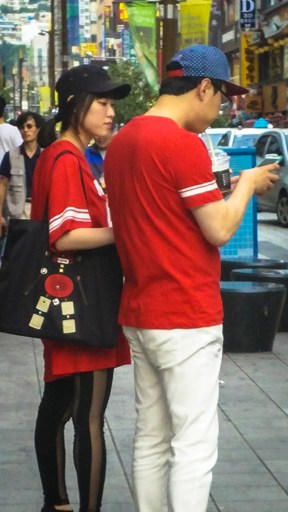
Korea is crazy for couples. It’s so crazy that it’s common for couples to display their affection by dressing in matching outfits. Korean couples aren’t just dressing similarly from having spent countless days together developing a strong emotional connection. They dress in exactly matching clothes bought for the sole purpose of identifying that they are, in fact, a couple and demonstrating to society that their love for each other is so profound that it emanates from their inner-core and manifests itself as matching textiles.

For my Yankee brain, with its deep ingrained necessity for independence and non-conformity, the Couple Tee, as it’s called in Konglish (Korean-English), is unfathomable, incomprehensible, and causes a small amount of vomit to reach my mouth each time I encounter this aberration of societal behaviour. My immediate reaction, after my involuntary one has subsided, is to be subversive. Is it possible to get custom made Couple Tees with “Friend” written on one and “with Benefits” written on the other? Or how about getting 3 shirts made with “open”, “relation”, and “ship”? One could go for a stroll as a couple and see if anyone wants to wear the 3rd shirt.

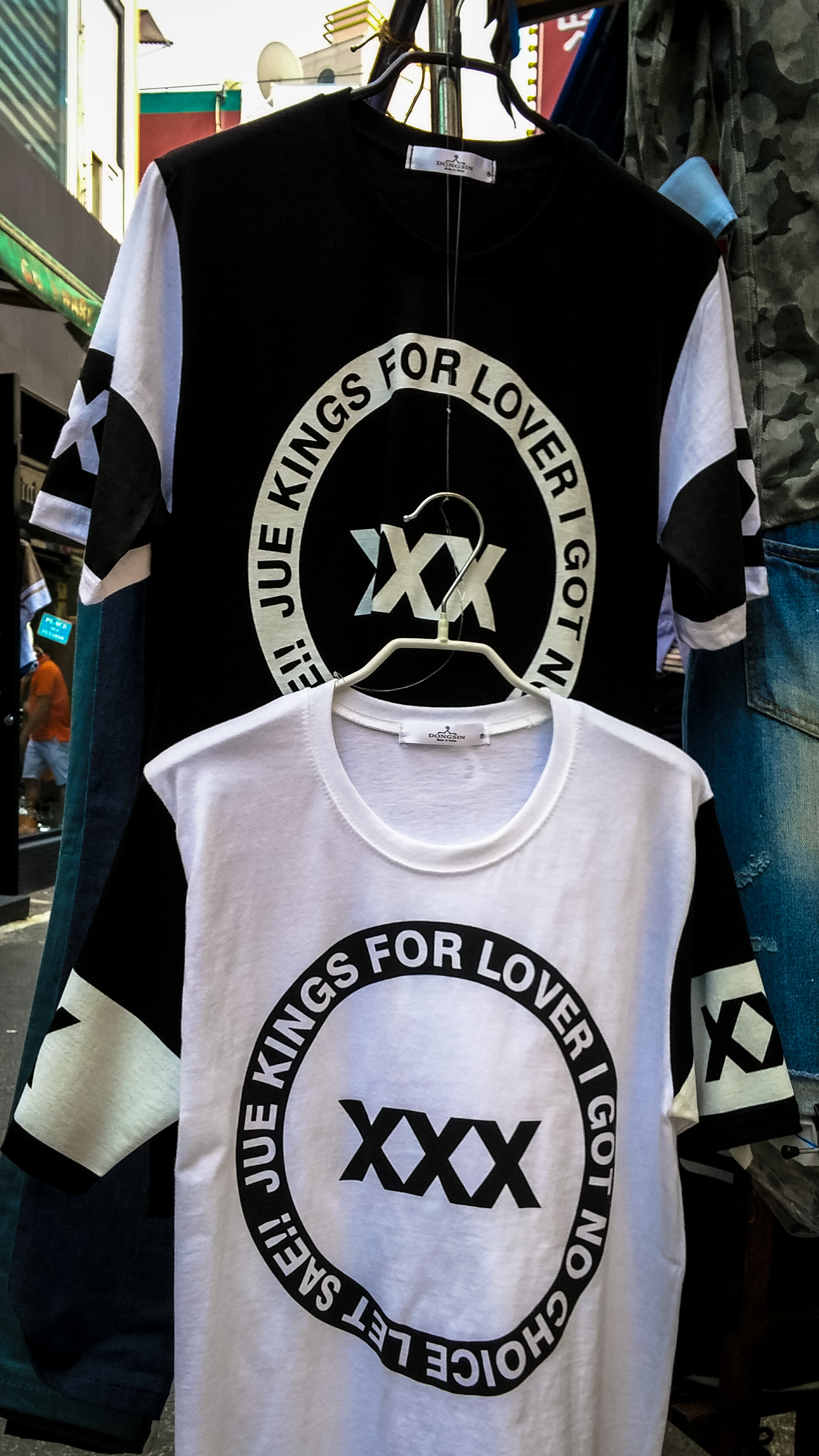
Below is an example of a Couple Tee pair. The non-sensical English writing on the shirts will be the topic of a future blog post. Non-sensical English on clothes is common here as is the liberal use of the word fuck – it makes for some interesting clothing options. Needless to say there is sufficient demand for Couples Tees that an industry exists to provide them. Fortunately, this subdivision of the clothing industry had the ingenuity to diversify its products into Couple Hats as well. This leads me to imagine: what is the ultimate Couple article of clothing? I’m imagining a colour-coordinated four-legged couple-onesie with shared poop flap – that would be next-level intimacy.
20140615_150313

Module III: Korean!

DSCF8404

Now that I’m completely fluent barely conversational in German and Japanese, it’s time for the third language: Korean!

Although Korean is unrelated to Japanese, it does have a lot of similarities. The word order is the same (Subject-Object-Verb), there are particles to mark the different parts of speech, adjectives and verbs are conjugated, and there are different rules based on the level of politeness and formalness required. This is all similar to Japanese.

A major difference is that Korean doesn’t have Chinese characters. As much as I enjoyed learning kanji in Japanese, I’m very thankful for the ultra-compact and logical Korean hangul alphabet which is easily memorized in 1 day. In the early 1900s, the language switched from Chinese characters to hangul and by the 1950s the use of Chinese characters was more or less phased-out. The hangul alphabet, which was designed in the 15th century, is extremely interesting. The shapes of the letters actually relate to the shape your mouth makes when saying them (see http://en.wikipedia.org/wiki/Hangul#Consonant_design).

That being said, Korean is supposed to be a difficult language to learn. The US Foreign Service puts Korean in category 3 (along with Japanese, Arabic, and Chinese) which ends up being about 4 times as many hours of study than category 1 languages like Spanish, French, and Italian. Keep in mind this is from the perspective of native-English speakers only — maybe Korean is easy if you speak Japanese natively!?

What did I learn from Module II: Japanese?

  • It’s great to have someone to work with one-on-one. Really it’s a must-have. In Japan, I was able to do language exchange with Sachiko for about an hour every day and also spoke with Yuka and Pon at the izakaya in the evenings. It was really a great situation for learning. That coupled with studying for a couple hours per day was sufficient to make decent progress.
  • Avoid foreigners. Even though there were a fair number of foreign visitors, Myoko Kogen is still very very Japanese i.e., it’s hard to find espresso. In Hakuba, it was easy to find espresso, i.e. not very Japanese. Go somewhere with less foreign influence and bring along a tin of Illy coffee.
  • Making flashcards is great fun. Daiso sells blanks.
  • Don’t spend a week reading reviews about ski gear instead of studying.
  • You won’t have 6-pack abs if you drink a litre of beer everyday no matter how much tofu and daikon salad you eat (see getdrunknotfat.com).

Goals for Module III: Korean:

  • Find a place with a nice beach but few foreigners. Right now I’m in Busan which has nice beaches but too many foreigners.
  • Get myself into a situation where I can speak Korean for at least a couple hours per day.
  • Learn how to surf or go sea kayaking or do some other fun water sport.
  • Koreans love to hike! When in Rome…
  • Make as many KakaoTalk friends as possible and text them in Korean! Plus send them hilarious emoticons like these.
  • Drink less beer! As the name of the popular Korean beer, Cass, would imply, Korean beer sucks. Stick with soju!
  • Drive around in a baller Hyundai with my tinted windows rolled down while I talk on my giant waffle-sized Samsung phablet.
  • I will be hard pressed to have as an amazing experience as I did Japan, but I will try my best. がんばります!